
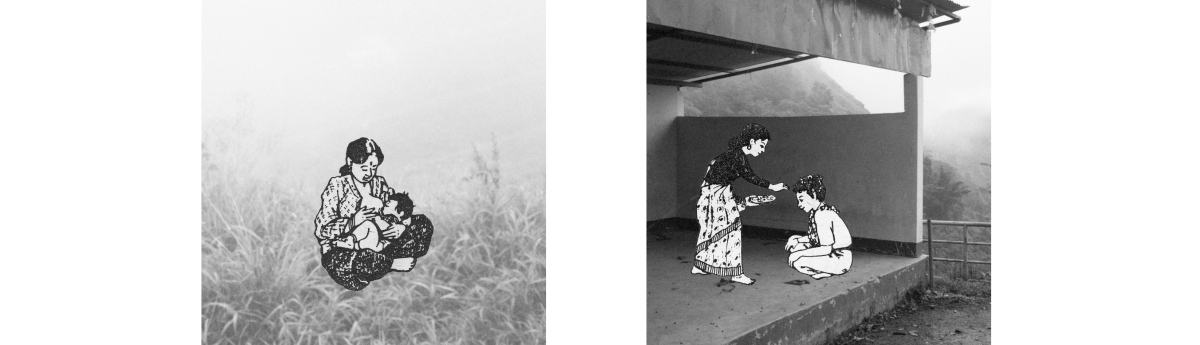
Bimal Fabbri was born in 1993 in Mankha, a village in Nepal’s Sindupalchowk district. After his mother was murdered and his father disappeared, he was left at the Balmandir Naxal orphanage in Kathmandu and adopted a year later by an Italian family in Milan. In order to adapt, he attempted to erase his native family from memory. The only image from his early childhood is an administrative photograph taken upon his arrival at the orphanage, a document of registration rather than affection. Rediscovering this photograph, together with a found video filmed at the moment of his adoption in 1998, initiated an ongoing artistic inquiry into origin and identity. Since 2012, his research-based practice has unfolded through photography, collage, drawing, and video, navigating institutional silences and fragmented archives. In 2022, after twenty-five years, he reunited with part of his biological family, learning that his father had been imprisoned for many years and that his sister had been adopted in the United States. Photography stands at the core of his work, functioning as a space of negotiation. His images consider how the body of a transnational adoptee carries displacement, adaptation, and absence. Returning to Nepal generated a deep sense of estrangement, resonating with Homi K. Bhabha’s concept of the “Third Space”: an in-between condition where identity is neither fully here nor there, but constantly in formation. For Bimal, photography operates as this third space, a field where cultural fractures, personal memory, and political histories coexist, and where identity remains open, unstable, and continually renegotiated.
Website: bimalfabbri.myportfolio.com
Instagram: https://www.instagram.com/bimalfabbri/
Copyright © 2026 Bimal Fabbri, all rights reserved